If you’re Trying to Get Buy-in, You’re Already Too Late
Do this Instead.
When leaders talk about needing buy-in, it usually sounds reasonable. It suggests alignment, communication, and shared direction. But buy-in is what leaders ask for after the most important decisions have already been made—without the people who will be expected to carry them out.
The strategy is defined. The priorities are set. The plan is ready to present.
Now the work is convincing everyone else to support it. But that doesn’t secure authentic commitment. It’s persuasion after the fact.
And it’s one of the reasons 60-70% of major business transformations fail to achieve their desired results. And 90% of organizations fail to execute their strategic plans.
Buy-in is a symptom of a deeper flaw in how leaders design strategy and decision-making. If you think you need to “get buy-in” then your process for decision making is broken.
“Buy-in is what leaders ask for when they’ve already made decisions without the people required to implement them.”
Communication Doesn’t Generate Commitment
Communicating decisions after they’ve already been made does not create commitment. It creates awareness.
When leaders present a finished strategy and invite questions, participation is limited to a small subset of voices—often those already aligned or those comfortable speaking up. Most of the organization listens, processes privately, and withholds reaction. What looks like agreement in the room is often untested understanding.
This is not because the leaders didn’t communicate well. It’s a limitation of the format.
One-way communication positions people as recipients of direction rather than contributors to it. It concentrates airtime with the speaker and minimizes the opportunity for others to engage, challenge, or shape what they are being asked to carry forward.
As a result, important concerns surface later—during execution—when they are more costly to address. What appears as resistance is often the delayed expression of perspectives that were never invited early enough.
Communication has a role. But it cannot substitute for participation in the thinking and designing that precedes it.
Execution Happens Between Functional Silos
Work today rarely sits neatly within a single function or chain of command. It moves across disciplines, geographies, and areas of expertise. Many of the most important initiatives—growth, transformation, digital integration—are executed not through hierarchy, but through coordinated effort across teams.
This is what many now describe as the project economy: organizations increasingly operate through temporary, cross-functional efforts that require alignment without relying solely on authority.
In this environment, no single leader holds a complete view of the problem. And no plan, however well constructed, can anticipate all the constraints that will surface once execution begins.
Strategies designed in isolation, then handed off for execution, are more likely to miss these realities. What follows is not simply resistance to change, but fragmentation: different teams interpreting the same direction through different lenses, shaped by their own pressures, incentives, and assumptions.
The more complex and interconnected the work, the less effective it is to rely on passive cooperation with decisions made elsewhere. What’s required instead is earlier engagement—bringing the perspectives of those closest to the work into the process before direction is fixed.
In the project economy, alignment is not something you achieve after decisions are made. It is something you build while those decisions are still taking shape.
Better Than Buy-in: Ownership and Identity
If leaders are presenting their finished strategy and thinking how do we convince others to support it, the most important thinking has already happened—without involving the people expected to carry it forward.
Commitment forms earlier, when leaders are involved in shaping how the organization understands its key challenges and what it believes it must change. People commit when they can see their own thinking reflected in the direction, not just their assigned responsibilities.
People commit to what they help define because it becomes part of how they see themselves. When leaders are involved early, strategy is no longer something they are asked to support. It becomes something they helped shape, and that changes how they show up. Their ownership and commitment is earned through participation, not persuasion.
Rather than begin with a fully formed plan, executives can begin by engaging their teams with questions:
- What is the core strategic challenge we need to address?
- How do we understand it differently across the organization?
- Do we have a shared sense of urgency?
These conversations surface differences in perspectives that can be addressed earlier, enabling execution to proceed more smoothly.
As the direction takes shape, the work shifts, but not to defending strategy. It shifts to engaging leaders in examining the conditions required for success. This is still a moment for engaging teams with questions, but now the questions revolve around what must be true:
- How are decisions made?
- How do teams work across boundaries?
- What behaviors are expected and reinforced?
- How do systems need to change to support the envisioned change?
- What are leaders prioritizing and modeling?
Framing the conversation this way does two things. First, it invites critique without confrontation. People are not being asked to challenge the strategy directly, but to examine whether the organization is prepared to support it. Second, it reveals the often unseen constraints—cultural, structural, behavioral—that determine whether execution will take off or grind to a halt.
When leaders participate in defining these conditions, the shared understanding turns passive agreement into active commitment.
Is Engaging All Leaders Possible?
Can we really engage entire companies or engage leadership teams to define core challenges and create solutions? The simple answer is “yes”. With a little planning, facilitated meetings can meaningfully engage 100% of the participants.
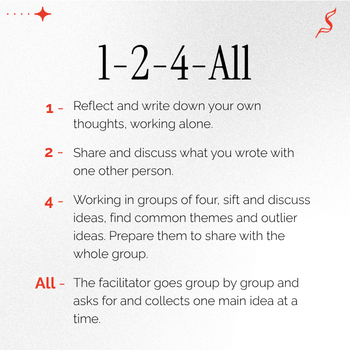 One example of how this can be done is a simple facilitation pattern known as 1-2-4-All. It’s not important that you use this specific method. What matters is this principle: structuring conversations so that every voice is heard, not just the loudest.
The 1-2-4-All technique doesn’t hinge on expertise, engages the introverts, creates safe spaces for sharing controversial views, and addresses group think biases. The whole cycle can take just a few minutes.
The principle is to distribute participation in meetings more evenly. By sharing the air, you will earn commitment because all participants are contributing, not just the speaker and the courageous extroverts.
Won’t it take too long?
I’ve encountered many leaders who think that engaging leaders in this way takes too long and wastes time. The view that collecting insights is a waste of time is common, but mistaken, because insights reduce waste. As you see above, it doesn’t require a great deal of time. And this investment will save time and resources later.
By revealing key differences in the perception of urgency, you will be able address it before it shows up as a lack of motivation during implementation. You will gain important insights into constraints in the business and the culture that can be invisible to executives. You need these insights so you can address them during strategy development.
Authentic commitment is critical to successful implementation, and a common cause of failure. This up-front investment will pay substantial dividends on the long journey of successful strategic change.
Design For Commitment, Not Buy-in
You don’t earn ownership and commitment at the end of a process when you’re announcing your new strategy. It’s something you earn by involving your leaders from the start and taking action together. If your strategy requires you to “get buy-in,” it’s worth asking who needed to be part of the conversation before the major decisions were made?